Lawn Replacement versus Lawn TLC

Depending where you live the snow is likely all but gone. The trees and tulips have started to bloom and the grass is growing. With the mild winter we experienced many people are faced with a pretty messy situation with regard to their lawn.

We had lower than normal temperatures in most surrounding areas; we also had plenty of ice and rain in comparison to snow. With the early spring and mild winter temperatures your lawn is likely ready for an upgrade.

Hopefully by now you’ve had a chance to get out and rake your lawn and assess the damage. Perhaps you were pondering lawn replacement last fall and have put it off until now. The big question is, do you resod the lawn, or just provide some TLC?

A number of people will simply head to the store and by some seed, throw it around the rough patches and hope for the best. This may work, but chances are it won’t. If you have areas of your lawn that are beyond repair you could go the TLC route however it could take a couple years until you see satisfactory results. Often people well tell you to simple rake aerate the lawn and then seed the area. Again this may work, but you may also be wasting time and money.

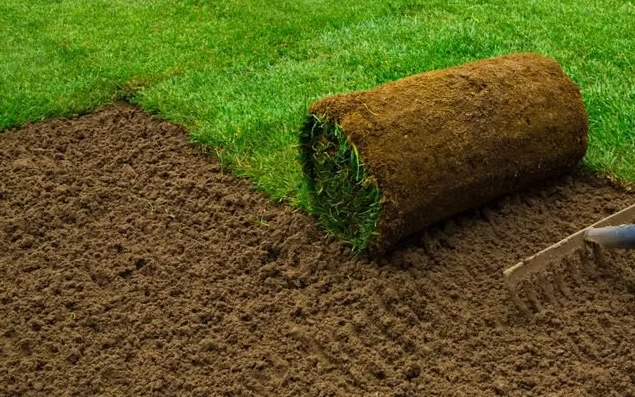
Sodding your lawn is another option that many people choose. When you look at the cost comparison on top of the labour required, resodding your lawn makes sense. Depending on the size of your lawn or area that needs to be replaced most professional companies can resod an average lawn in about a day. The results are immediate, and the labour minimal for the homeowner. Once sodding is complete you just need to make sure to water appropriately, twice a day when dry and hot, and once in the afternoon if the temperatures are cool. It is important that you ensure that traffic on your new sod is kept to a minimum.  If you have pets make sure they are not digging up your new lawn. It is also important to watch of other critters that can ruin your new sod. Raccoons and skunks for example are known for tearing up new sod in search for food. Pegging a few stakes helps to eliminate this problem. It is best to consult with your lawn care professional.

In conclusion, you need to assess your lawn, if you are unsure a call to a reputable company is advisable. The last thing you want to be doing now that the nice weather is here is wasting time and money on the newest lawn care gimmick that is advertised.

Enjoy the nice weather and leave the lawn repair up to the professionals.

What You Need to Know about Choosing the Right Landscaper

Choosing a landscaper to improve the look of your property is a wise choice. Whether you are looking to hire a landscaper to repair a few bad spots in your lawn, or to provide a complete overhaul of your property there are some essential things you need to know.Choosing the Right Landscaper

If you’re seeking a landscaper for a rather simple job you may want to look into doing the job yourself. For the most part landscaping companies and individual landscapers are quite busy, and most are looking for the big projects. A bothersome trend that we have come across with regard to contacting and attempting to set up appointments with various companies resulted in 90% of them either not responding or neglected to show up at all. This is bad business and you want to be careful if you’re considering hiring companies that can’t even provide good communication from the start.

There are a variety of options available to improve the look of your property. Popular themes the last few years range from the basic flowerbeds, to entire property renovation including; garden pathways, waterfalls, rock gardens, underground sprinkler systems and strategic lighting.

Some things that you want to watch for when seeking a landscaper:

  • How long have they been in business
  • Do they have insurance
  • Are the registered with the BBB
  • What is their reputation like, will they provide references
  • Do they seem professional to you
  • Are estimates free and provided in writing, are they detailed
  • Do they require a signed contract

These may seem like basic things to look for but you would be surprised at how many people neglect to ask. When you meet with them, it is always a good idea to go with your gut. Did they show up late? Are they neat in appearance? Do they seem pushy? Do they take the time to listen to what you want/need?

Once you have decided on what the project will entail, it is a good idea to get a few quotes. Compare them against each other, Company ‘A’ maybe $2000 cheaper but maybe they are using substandard soil, or cheaper tile etc. make sure you are comparing apples to apples. Never hire a company that does not have insurance, you don’t want one of the summer students accidentally taking out your fence, or pool with a backhoe and the company not be insured. Avoid any company that asks for large amounts of money upfront. A reputable company should have resources to get started; you should not have to provide a large sum of money before the work begins. Depending on the size of the job, often you will be asked to sign a contract which may have detailed payment release options. These options should be reviewed and agreed upon. Be smart and go with your gut, check references, do a bit of research. We’ve all seen Holmes on Homes, the last thing you want is the person taking off with your money and end up needing to call Mike Holmes.

Lawn Care Tips- Mowing the Grass

I don’t know about you, but I just love mowing my grass. There is nothing better than the smell of fresh cut grass and the feeling of a warm summer breeze on my face. I have a feeling that I am in the minority when it comes to lawn care and grass cutting. I am forever cursing those in my neighborhood that neglect their properties. Every community has them, the guy with the 3 foot lawn that is mostly weeds and dandelions. Lawn Care Tips Mowing the Grass I had a thought late last summer that perhaps they didn’t understand the concept, or the importance of proper lawn maintenance. In this article I will touch on some of these important aspects and provide some lawn care tips for mowing the lawn.

The most important thing is your mower. You want to make sure that you properly maintain your lawn mower. Second make sure your lawn is clean and free of clutter. A quick rake to remove rocks and branches will protect your mower blades. It is extremely important that you keep the blades sharp, this allows for a crisp clean cut which allows for your lawn to grow. Make sure after you have mowed the lawn that you clean all the grass out from under your mower, I prefer using an old chisel and small broom to scrape out the underbody of the mower. Adjust the height of the blades if you have a ride on mower, push mowers you can adjust the wheel height. You want to cut the grass low in the spring and let it grow longer as the hot months approach. Grass that is longer takes in more sunlight, and water which allows for a strong root base. This can cut down on the spread of weeds. Depending on your location and the type of grass you have the ideal length is between 2-4 inches.

The last aspect is the mowing itself. You want to make sure your cutting your grass at regular intervals. Once a week is the norm, make sure the grass is good and dry before you mow. Mowing a wet lawn is not a good idea, not only is this harmful for your mower but also creates more work as you will have clumps of wet grass all over your lawn. When the lawn is dry and you mow the clippings can be left in place. Last bit of advice I can provide is direction. It is a good idea to alternate the path you take when you are mowing your lawn, if you go east west one week, mow north south the next week. This allows for the grass to grow fuller and prevents wear pattern.

Lawn Replacement Synthetic Turf or Sod

This is a common question that seems to be popping up in the industry more and more every year. Should you go with a Synthetic Turf as opposed to Sod when replacing your lawn? There are a few things to keep in mind here including, cost, environmental benefits good or bad, and the appearance factor.Lawn Replacement Synthetic Turf or Sod

Depending on whether or not you enjoy caring for your lawn the answer is rather simple in my opinion. If you dislike raking, weeding, treating and mowing your lawn then perhaps an artificial lawn is for you. There are some pros and cons with regard to this thinking however; first and foremost in most people mind is the cost. Today the cost is quite comparable to real turf. When artificial lawns first hit the market they were the new big thing and the cost was very high. Similar to the first LCD TV’s the costs have come down considerably. Some experts suggest that replacing your lawn with an artificial turf will pay for itself over the next 5 years. The idea is you will save money on the maintenance of your lawn, in essence paying for your new artificial lawn.

There are some positives with regard to the environmental factors. Clearly cutting down on fuel emissions is an important factor and going from sod to artificial grass solves this problem. There is also a decrease in the amount of water waste as there is no need to water an artificial lawn. No need to use chemical sprays and other pesticides to treat the lawn either. So from an environmental standpoint replacement makes a lot of sense.

Making the switch to an artificial lawn rather than resodding your lawn is a personal choice. Depending on the size of your lawn and what is required the process of making the switch is relatively easy.  In the past the turf that was used for sporting facilities was deemed as unsafe and manufactured using harsh chemicals. This is not the case today, most of the product on the market today is entirely eco-friendly made of Polyolefin.

As mentioned the move to artificial turf as opposed to a real growing lawn is a personal one. Depending on the condition of your current lawn it may make sense to make the move to artificial. It doesn’t take long to figure out the cost saving when you look at the increase in fuel costs every year, there are also costs associated with fertilizing, weed and feed, seeding, aeration etc. This does not factor in the time you spend on your lawn as well. One of the most painful aspects for me is raking. With an artificial lawn you can throw the rakes in the garbage, invest in a blower and the job is twice as easy. I enjoy my lawn, and spending time keeping it looking good, but after researching and writing this article I am seriously considering replacement next time I am faced with a lawn disease of sorts.

Selling Your Home? Before You List It, Stage It

Curb appeal sells homes. If you have purchased a home or are thinking about buying or selling you know what I’m talking about. When we purchased our first home the first thing we did was tour around the city checking out the homes in the MLS listings. Selling Your Home Before You List It Stage ItrYou pull up to the curb and what is the first thing that catches your eye? The answer is about 50/50 some see the house first, some see the property. If the property is not appealing often people will drive on to the next house. The statement “Before you list it, stage it applies to this thinking.

Having an appealing property will draw more people to your home and provide a positive first impression. This also brings more value to your home; people will feel more comfortable knowing that you have taken total care of your home and property. Staging your property can be done in basic fashion, or it can be a larger investment. You want to be sure that the lawns are cut and trimmed and in good condition. Ensure the bushes and or hedges are clipped and that there is no debris or clutter. If there are flower beds present make sure you have weeded them adding a few colorful plants or cedar mulch also adds flair depending on the season. Make sure that everything is in its place. You don’t want toys and bikes cluttering the yard, at the same time you want to make sure if you have a pool or garage that they are clean and neat.

Some other tips with regard to the property include allowing the buyers to pull right in to your driveway. Park your own vehicles at a neighbor’s house; you want the people looking at your home to feel like they are pulling into their future home. Ensure that everything is clean, painted, and repair any screens, broken windows, decking etc. Do a 360 view of your property from various points, front, back and side of the property. Imagine what those that will be looking to buy will be viewing. Is there anything out of place or that needs improvement?

Most of the required staging of your home you can do yourself. If you are looking at investing a little money in hopes of a return on the sale consulting with a landscaping company is a good idea. They can provide you with additional tips and tricks to improve the look of your property. Simple things such as having a flower bed strategically placed, or some pillar lighting at the end of the driveway adds a special touch.

Spending a little time, effort and money on the exterior of your home will payoff in the long run. As mentioned if buyers see a property with knee high grass, and weed everywhere this instills a negative attitude right from the start. Often people will be immediately concerned that if the outside looks that bad the inside must also be awful. This can result in many home seekers passing on your property, thus costing you a potential sale. A little bit of elbow grease can go along way.

Maintaining Your New Lawn

Aeration
Aerating your lawn allows a better flflow of water, air and vital nutrients to the plant roots, making it easier for them to grow. Aeration is best done in early spring and fall and can be done in conjunction but prior to overseeding and/or topdressing. (call us in the early spring or fall to have us aerate your lawn!)
Landscaping-Ottawa, Maintaining Your New Lawn
Overseeding

  • Regularly spreading grass seed on your lawn will ensure that it remains dense.
  • Over-seeding is best done in late summer to early fall.
  • Topdressing with compost or topsoil can be done at the same time.
  • Using the proper type of grass seed is very important for lawns in shady areas.

Raking/ Dethathing
Raking will be your first task of spring lawn care. Okay, I can hear the groans coming from all lands near and far. Raking is for controlling thatch (dead grass) and stimulating the grass roots so it’s advised to do this at least once a year.

Fertilize Your New Lawn

  • The type of fertilizer you use and the timing of the application are important. Compost or slow-release fertilizers are preferable, and fertilizing in early fall promotes vigorous lawn growth the following spring.
  • Before fertilizing lawns, read the instructions on the bag carefully (or ask someone at the store for details). Should you wish to let the pro’s handle seasonal fertilizer and grub treatments call Green Unlimited at 613-744-7336
  • Regular fertilizing is important not only for your new lawn but for your established lawn too, It provide essential nutrients to your lawn and also keep your new lawn lush and thick in order to help reduce and choke out weeds.

Mowing Your New Lawn

  • When your newly installed lawn has reached a growth of 4-5 or more inches you can begin to mow it. Do not let it grow much longer than five inches
  • Set your mower’s height adjustment to its maximum for the  first couple cuts and gradually lower the setting. Do not mow shorter than 3”.
  • Don’t worry about picking up the clippings – leave them right where they fall. They’ll decompose quickly and provide a nitrogen boost to your new lawn (but do remove any particularly large clumps of cut grass immediately after mowing). After you’ve finished mowing, water your lawn well. Sod/grass goes into mild shock after it’s been cut, and watering helps regain its food-synthesizing capacity.

TIPS

  • Be careful when mowing for the first couple times. The grass roots will typically be very shallow and can be damaged easily.
  • Keep your mower blade sharp!
  • As with all lawns (new or old) make sure the grass is dry when you mow. In fact, mid afternoon mowing is always best
  • Think of mowing your new lawn like pruning: It makes your grass healthier by allowing light down to the root crown, encouraging it to produce new blades to spread out and fill in, creating that uniform, dense carpet we all know and love.

Watering Your New Lawn

The MOST IMPORTANT ELEMENT to ensuring the success of your new lawn!

IMMEDIATELY water your lawn after it’s installed until it’s completely saturated and the soil under the middle of the sod roll is wet. If watered insufficiently, the middle of the roll will still be dry causing yellowing of grass. You can check to ensure the sod and soil are wet or damp by lifting up a corner- have a peak!
Landscaping-Ottawa, Maintaining Your New Lawn

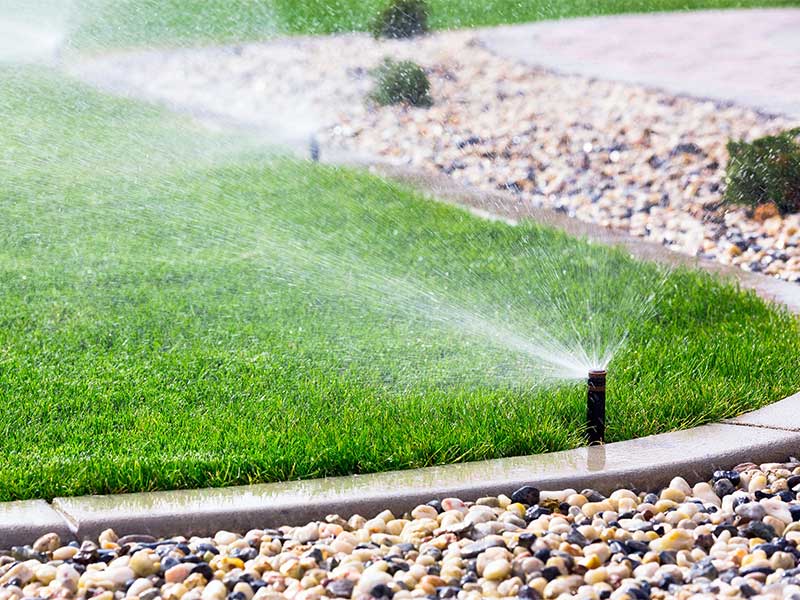
Watering times varies depending on your sprinkler system and how hot it is outside but 2 – 3hrs is generally our recommendation. (approx 1-2” of water) Put a water gauge or a tuna can on your lawn to measure the amount. The best time to water is in the early morning (before 8am) this minimizes water lost through evaporation and wind. Watering in the evening leaves the grass wet for longer, increasing the risk of disease.

TIPS

  • Do NOT walk on grass immediately after install- you’ll likely sink if it’s watered adequately.
  • Use your judgment based on how hot it is outside. In the middle of summer the lawn will require longer watering applications.
  • The soil should NEVER dry out before the roots grow into the soil (first 10 days).
  • Avoid frequent light watering which results in shallow rooting and water for longer periods less often.
  • Allow about 10 days before heavy traffic.